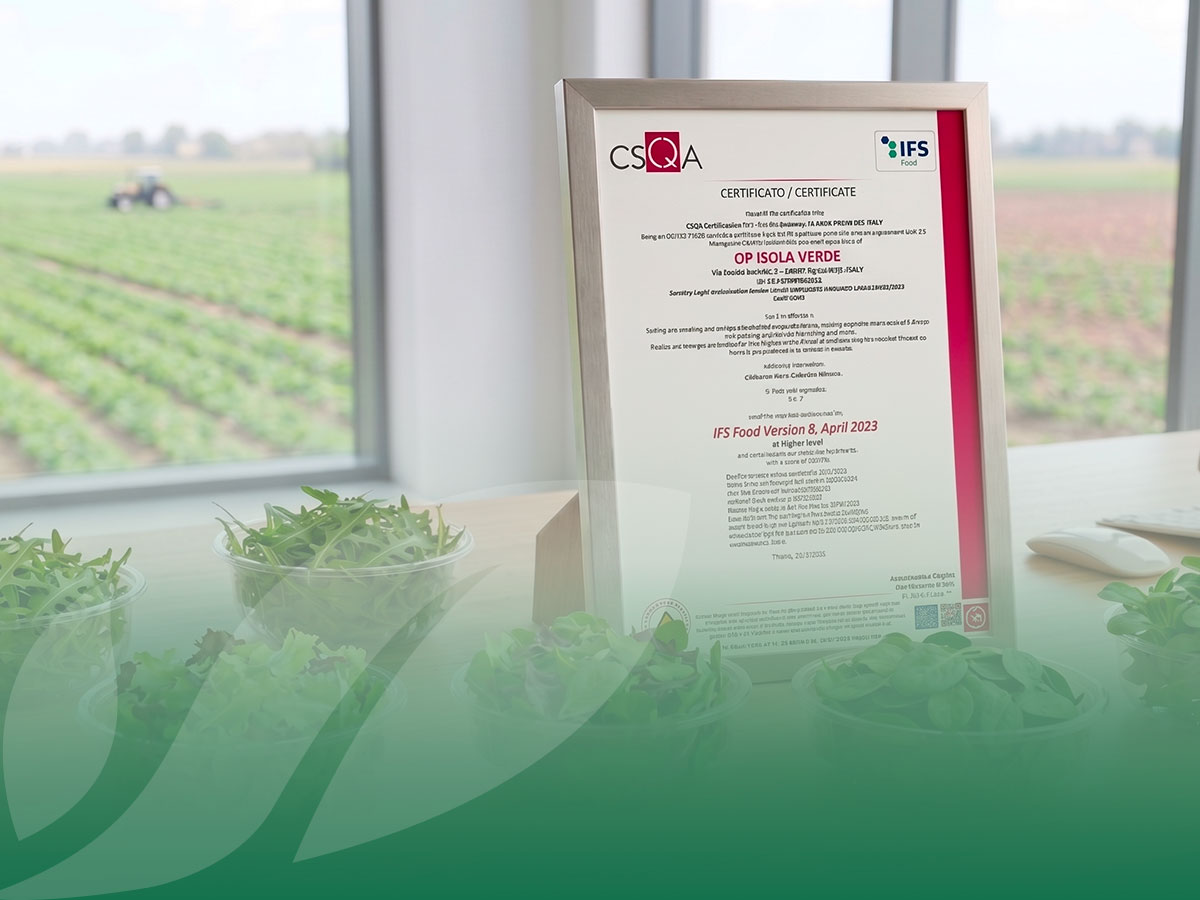
IFS Certification: Requirements and Benefits for Consumers and Large-Scale Retail
Discover IFS certification: requirements, benefits for retailers, and food safety. OP Isola Verde’s commitment to your fresh Baby Leaf salads.
In the food sector, especially when we talk about delicate and ultra-fresh products like our beloved Baby Leaf salads, safety is not just a promise: it is a daily responsibility.
At OP Isola Verde, we work every day to ensure that the vegetables reaching your tables are not only delicious but 100% safe.
Today, we want to take you “behind the scenes” of our agricultural supply chain to explore a topic essential to global quality.
Let’s discover together everything you need to know about IFS certification: requirements, control parameters, and why it represents a massive advantage for the entire market.
1. What is the IFS Standard?
IFS (International Featured Standards) is a rigorous international standard established to assess and certify the compliance of food products and processes.
As a fully recognized GFSI certification (a globally acknowledged standard by the Global Food Safety Initiative), its main objective is to guarantee that the manufacturing company operates according to the best and safest international practices.
This certification ensures transparency throughout the entire supply chain, from the cultivation field to packaging and shipping.
2. Safety in practice: the pillars of the standard
To pass audits and maintain high-quality levels, companies must adhere to extremely strict criteria.
But what, specifically, are the fundamental IFS certification requirements to implement?
Let’s look at them together:
- Implementation of the HACCP system: a robust, documented, and constantly updated HACCP plan is the heart of the certification. It serves to identify, evaluate, and tightly control any potential food safety and hygiene risks associated with food processing.
- Production process control: from the sowing of our Baby Leaf greens to washing and packaging, every operational phase must be tracked and monitored to prevent any type of contamination.
- Management responsibility: quality is a corporate culture. IFS requires management to be directly involved in the development and continuous improvement of food safety policies.
Benefits for Large-Scale Retail (GDO) and Industry Operators
For Large-Scale Retail (GDO), IFS certification represents much more than a bureaucratic document: it is a true passport of reliability.
Choosing certified suppliers allows retailers to protect their brand, simplify and standardize supplier audits, and ensure consistent, excellent supplies to their points of sale.
Freshness and Guarantee for the Consumer
What does all this mean for you when choosing your salad at the supermarket? Simple: it means bringing to your table a traceable, healthy product grown in full compliance with regulations and the environment.
It is the peace of mind of dressing your Baby Leaves knowing that behind every single leaf lies careful, rigorous, and certified work.